
by William Parker | Apr 15, 2022 | Observatory, Observatory Events, One-Time
Friday (Apr. 22) 9:00 pm – 11:00 pm
The Lyrids appear in Chinese writing dating back to roughly 690 BCE, making them one of the earliest meteor showers on record. On the night of April 22, the annual shower will make its appearance for 2022. The meteor shower is a result of Earth passing through the tail of the comet C/1861 G1 Thatcher. When our planet moves through this debris field, the space rocks burn up in Earth’s atmosphere, causing spectacular lights to streak across the night sky.
The Lyrids are one of the weaker annual meteor showers visible from Earth. On peak nights, they usually produce no more than 20 shooting stars per hour. The event is also unpredictable: On rare occasions, spectators are treated to incredible surges of up to 100 meteors per hour. For this reason, the Lyrids are worth checking out for diehard astronomy enthusiasts.
Come out to the Schoolyard Observatory and enjoy a relaxing evening in our anti-gravity chairs as we point out the night-sky objects and watch for meteors.
Tickets are limited so reserve soon.
This event is weather-dependent and will be canceled or rescheduled by e-mail 24 hours before the scheduled start time in the event of a cloud cover forecast greater than 30%. Reservations can be transferred for any other nightly event.
Dress appropriately for being still in nighttime outdoor weather.
Questions? Feel free to contact us at observatory@hawthornhollow.org
Purchase tickets here, or call 262-552-8196.

by William Parker | Nov 17, 2021 | Observatory, Observatory Events, One-Time
Friday (Nov. 19) 1:00 am – 4:00 am
The longest partial eclipse of the century!
A partial lunar eclipse is coming up this month – and it will be the longest of this century. The eclipse will take place overnight on November 18 and 19, when the moon slips into Earth’s shadow for 3 hours and 28 minutes, NASA said. The late November moon is also known as the “frost moon.”
Partial lunar eclipses occur when the moon does not pass completely into Earth’s shadow.
Eclipses aren’t everyday occurrences on Earth, and they’re not always easily visible. While some viewers might have to contend with middle-of-the-night scheduling for this month’s celestial event, it’s worth taking a moment to marvel at how the moon, the sun and our planet are connected as residents of this solar system.
Head on over to The Schoolyard Observatory early Friday morning and view the rare event while relaxing in our anti-gravity chairs, learning about the night sky with a guided tour, and see some spectacular telescope views.
Have questions? Please contact us at Observatory@hawthornhollow.org.
Purchase tickets here or call 262-552-8196.

by William Parker | Aug 18, 2021 | Observatory, Observatory Events, One-Time
Tuesday (September 14) 7:00 pm – 9:00 pm
Mercury’s orbit lies closer to the Sun than the Earth’s, meaning it always appears close to the Sun and is lost in the Sun’s glare much of the time.
It is observable for only a few weeks each time it reaches the greatest separation from the Sun – moments referred to as greatest elongation. These apparitions repeat roughly once every 3–4 months, taking place alternately in the morning and evening skies, depending on whether Mercury lies to the east of the Sun or to the west.
When it lies to the east, it rises and sets a short time after the Sun and is visible in the early evening twilight. On September 14 it will have a 26.8° eastern elongation. Observing conditions will be better at lower latitudes, from where it will be setting approximately 1.5 hours after the sun.
Come out to the Schoolyard Observatory where we will take a trip to the Western field and view Mercury through binoculars and a few field telescopes. After which we will explore other planets and our moon through our telescopes.
This 2-hour session will be confirmed by email at least 24 hours before scheduled according to the cloud cover forecast (< 30%). Tickets are transferable for any observatory nightly event in cases of poor weather conditions.
Have questions? Please contact us at Observatory@hawthornhollow.org.
Safety Precautions: During events, 6-foot social distancing will be maintained, and wearing face masks are recommended but not mandatory. Telescope eyepiece and ladder handles will be sanitized before and after each use. Dress appropriately for nighttime outdoor weather, and plan for the blood-sucking flying insects.
Purchase Tickets Here or call 262-552-8196.
by Chad Jocius | Jul 19, 2021 | Observatory, Observatory Events, One-Time
Thursday (August 12) 11:15 pm – 1:15 pm
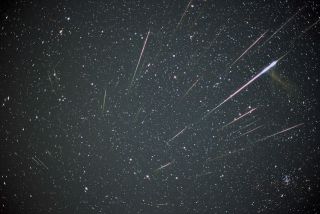
This year, the Perseid meteor shower will reach its peak on the nights of Thursday, August 12, and Friday, August 13. In recent years, the moon has made it difficult to view the shower, but that won’t be the case in 2021. The Perseids’ peak comes just a few days after a new moon. On August 12 and 13, a dim waxing crescent moon will set early in the evening, leaving dark skies and perfect stargazing conditions. You can expect to see up to 100 shooting stars per hour on these nights.
Reserve your tickets for The Schoolyard Observatory Perseids Meteor shower event and enjoy a relaxing display of the meteors as you lay back in our zero gravity chairs. Tickets for this event go fast so reserve yours today.
Each 2-hour session will be confirmed by email at least 24 hours before scheduled according to the cloud cover forecast (< 30%). Tickets are transferable for any observatory nightly event in cases of poor weather conditions.
Have questions? Please contact us at Observatory@hawthornhollow.org.
Safety Precautions: During events, 6-foot social distancing will be maintained, and wearing facial masks are recommended but not mandatory. Telescope eyepiece and ladder handles will be sanitized before and after each use. Dress appropriately for nighttime outdoor weather, and plan for the blood-sucking flying insects.
Purchase Tickets Here or call 262-552-8196.
by Chad Jocius | Jul 19, 2021 | Observatory, Observatory Events, One-Time
Thursday (August 12) 9:00 pm – 11:00 pm
This year, the Perseid meteor shower will reach its peak on the nights of Thursday, August 12, and Friday, August 13. In recent years, the moon has made it difficult to view the shower, but that won’t be the case in 2021. The Perseids’ peak comes just a few days after a new moon. On August 12 and 13, a dim waxing crescent moon will set early in the evening, leaving dark skies and perfect stargazing conditions. You can expect to see up to 100 shooting stars per hour on these nights.
Reserve your tickets for The Schoolyard Observatory Perseids Meteor shower event and enjoy a relaxing display of the meteors as you lay back in our zero gravity chairs. Tickets for this event go fast so reserve yours today.
Each 2-hour session will be confirmed by email at least 24 hours before scheduled according to the cloud cover forecast (< 30%). Tickets are transferable for any observatory nightly event in cases of poor weather conditions.
Have questions? Please contact us at Observatory@hawthornhollow.org.
Safety Precautions: During events, 6-foot social distancing will be maintained, and wearing facial masks are recommended but not mandatory . Telescope eyepiece and ladder handles will be sanitized before and after each use. Dress appropriately for nighttime outdoor weather, and plan for the blood-sucking flying insects.
Purchase Tickets Here or call 262-552-8196.

by William Parker | May 28, 2021 | Observatory, Observatory Events, One-Time
Saturday (June 5) 9:30 pm – 11:30 pm
The Milky Way sits near the middle of an assembly of galaxies called the Local Group. This gathering, 10 million light-years wide, lives on the edge of an even larger collection of galaxy clumps called the Local, or Virgo, Supercluster.
As telescopes became more powerful, astronomers could take larger surveys, cataloging more galaxies and their motions, forming a bigger picture: galaxies concentrated along a plane in space. Just as most of the Milky Way’s stars reside in a thin disk, so do most of the galaxies in the Local Supercluster lie along the supercluster’s equator. The center of our supercluster shares a spot in the sky with the constellation Virgo.
Come out to the Schoolyard Observatory as we take you on a trip to our “closest” neighbors within the Virgo Supercluster.
Each 2-hour session will be confirmed by email at least 24 hours before scheduled according to the cloud cover forecast (< 30%). Tickets are transferable for any observatory nightly event in cases of poor weather conditions.
Have questions? Please contact us at Observatory@hawthornhollow.org.
Safety Precautions: During events, 6-foot social distancing will be maintained, and wearing a facial mask will be required. Telescope eyepiece and ladder handles will be sanitized before and after each use. Dress appropriately for nighttime outdoor weather, and plan for the blood-sucking flying insects.
Purchase tickets here or call 262-552-8196.
